Why AI Needs a Human in the Loop
AI cannot be the legal signatory; the future of AI in quality is augmenting experts through rigorous Human-in-the-Loop architecture

The Promise and the Anxiety
The promise of Artificial Intelligence (AI) in Life Sciences is often painted in broad, transformative strokes: drug discovery in days, autonomous robotic surgery, and self-correcting supply chains. However, for the Quality and Regulatory professional, the introduction of AI brings immediate, pragmatic anxiety.
The core of this anxiety is the "Black Box" problem. Regulatory frameworks—whether FDA 21 CFR Part 11 for electronic records or EU AI Act classifications for high-risk systems—are predicated on traceability and accountability. If an algorithm erroneously decides a batch of insulin is safe to release, or if an LLM determines a customer complaint does not require a Medical Device Report (MDR), who is responsible?
AI cannot be the legal signatory. Therefore, the future of AI in quality is not about replacing the expert; it is about augmenting them through a rigorous Human-in-the-Loop (HITL) architecture.
The Power (and Peril) of AI in Compliance
The potential for AI to assist in Quality Management Systems (QMS) is undeniable. Natural Language Processing (NLP) can read thousands of customer complaints in minutes, identifying semantic patterns that suggest an emerging failure mode long before a human reviewer would spot the trend. Computer Vision can inspect packaging seals with a consistency that exceeds the human eye.
However, these models are probabilistic, not deterministic. A Large Language Model (LLM) might summarize a regulatory guidance document with 99% accuracy, but that 1% "hallucination" could lead to a critical non-conformance. The FDA's "AI/ML-Based Software as a Medical Device Action Plan" emphasizes the need for transparency and real-world performance monitoring. The same logic applies to AI used within the quality system (RegTech).
Designing the Human-in-the-Loop Pattern
To deploy AI safely in a GxP (Good Practice) environment, we must design workflows where the AI acts as a sophisticated screener, not the final judge.
1. Triage and Tag
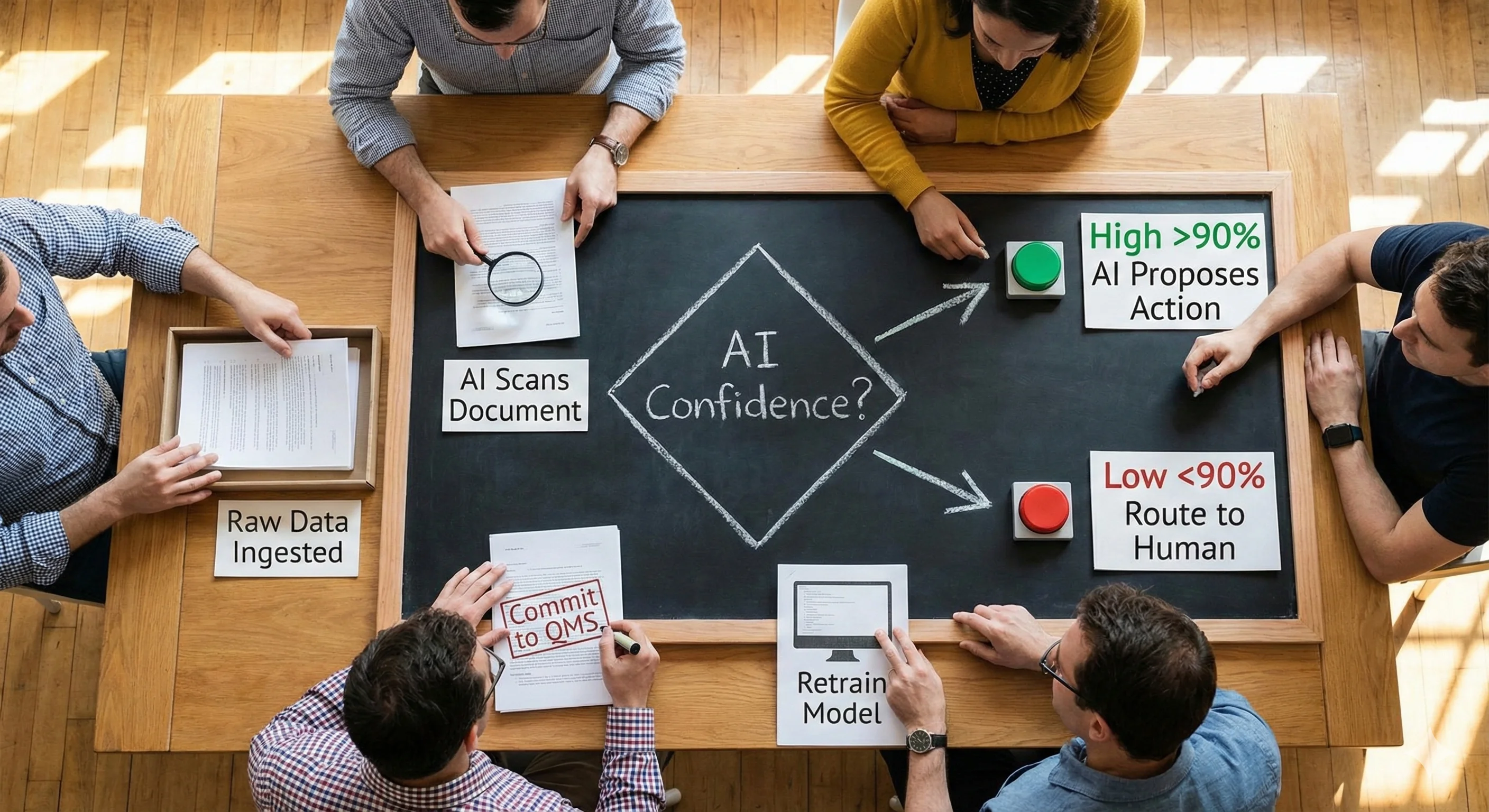
In this pattern, the AI ingests raw data—such as supplier audit reports or raw material certifications—and performs the initial "triage." It tags the document: "This looks like a standard ISO 13485 certificate, valid until 2026." It then presents this analysis to a human quality engineer. The human's job is not to read the whole document from scratch, but to validate the AI's assessment. This reduces the cognitive load by 80-90% without removing human oversight.
2. Anomaly Detection
AI is excellent at spotting outliers. In a "Review by Exception" model, the AI scans logs (e.g., sterilization temperature curves) and flags only those that deviate from the historical norm. The human expert then investigates the anomaly. This aligns with ISO 14971:2019, which requires risk management to be an ongoing lifecycle process. AI becomes the "radar," while the human remains the "pilot."
3. The Audit Trail of the Algorithm
Governance requires that we track not just the human's decision, but the AI's suggestion. If the AI suggests rejection and the human overrides it, that divergence is a critical data point. It indicates either a gap in the model's training or a unique nuance seen by the expert.
The "Propose and Dispose" Workflow
How does this look in practice? It's a loop of proposal and disposal.
Why This Matters
This architecture solves two critical problems:
Speed: The AI creates the draft. It tags the document: "This looks like an ISO 13485 cert, valid until 2026." You don't have to read the whole PDF; you just verify the tag. This reduces cognitive load by 90%.
Safety: You, the expert, retain the "kill switch." If the AI is wrong, you catch it. And crucially, your correction teaches the AI, making it smarter for next time.
Practical Governance: Who Watches the Watchers?
Implementing HITL requires a governance framework. The NIST AI Risk Management Framework suggests "Map, Measure, Manage, and Govern" as core functions. In a life sciences context, this means:
- Validation: You must validate the intended use of the AI tool within your QMS, just as you would any software validation under CSA (Computer Software Assurance) guidelines.
- Thresholds: Setting confidence intervals. If the AI is only 70% sure of a document classification, it should not auto-tag it; it should route it to a "Manual Review" queue.
The Symbiosis of Speed and Judgment
We must stop viewing AI and human expertise as opposing forces in a zero-sum game. In the high-stakes world of life sciences, they are symbiotic. AI provides the velocity required to handle modern data volumes; humans provide the context, ethics, and accountability that algorithms lack.
The organizations that prevail in the next decade won't be the ones that automate everything blindly, nor the ones that refuse to automate anything. They will be the ones that master the "handoff"—the precise moment where the machine stops proposing and the expert steps in to dispose. This is not just a technological challenge; it is a governance challenge. Are we prepared to trust the machine enough to let it help, but doubt it enough to keep checking its work?
Stay Updated
Get the latest insights on compliance automation delivered to your inbox.